Inside the world of orangutans
Blog
Learn about the lives of orangutans and the dangers they are facing.
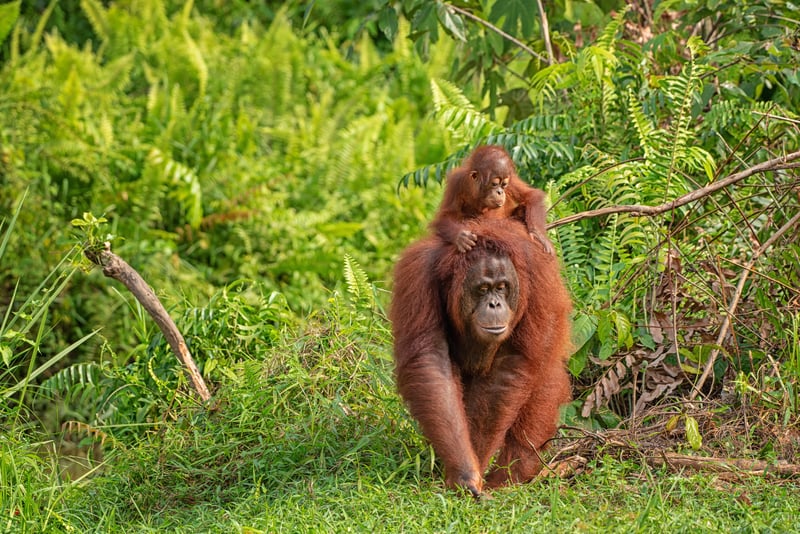
From their unusually long childhoods to their important role in keeping forests healthy, here are some fascinating facts about Sumatran orangutans.
About Sumatran orangutans
The Sumatran orangutan is critically endangered and is among the 25 most endangered primate species in the world.
There are three species of orangutan: the Bornean orangutan, the Sumatran orangutan and the Tapanuli orangutan, which was confirmed as a separate species in 2017.
There are only around 11,000 Sumatran orangutans left in the wild, and they are disappearing faster than they can reproduce. New research shows that more than one in ten orangutans are lost every year. If we don't act now, they simply cannot survive.
Every birth counts
Female orangutans only give birth once every six to eight years, the longest interval between births of any mammal.
Orangutan babies stay with their mothers for up to seven years, longer than any other mammal. During this time, they learn everything they need to survive in the wild, from finding food to navigating the forest canopy.
The people of the forest
The name orangutan is of Malayan origin and means "person of the forest".
Wild orangutans are found only on the islands of Borneo and Sumatra, mainly in Indonesia and also in the Malaysian states of Sabah and Sarawak.
Why orangutans matter
Orangutans don't just live in the rainforest, they also help keep it alive. As they move through the canopy, they disperse seeds that grow into the next generation of trees, helping to shape and regenerate the forest with every meal.
Why are orangutans being taken from the wild?
Baby orangutans are highly sought after in the illegal wildlife trade. Taken from their mothers, they are sold as pets and kept in poor conditions, often confined to tiny cages where they are unable to climb, forage or behave as they would in the wild.
While orangutans may appear docile as infants, they become increasingly strong and unpredictable as they mature. At this stage, owners often resort to keeping them permanently confined, selling them back into the illegal wildlife trade or, in some cases, killing them.
 © YEL
© YEL
Exploited for entertainment
Some orangutans are used in tourist attractions, where they show clear signs of stress and anxiety. In some cases, they are even drugged so that tourists can pose for photographs with them.
 © World Animal Protection
Killed for consumption
In some horrific cases, orangutans are traded as bushmeat, killed and sold for consumption despite their critically endangered status.
 © World Animal protection
If you'd like to learn more about the work we are doing to protect orangutans, please visit our orangutan appeal page:

Join operation orangutan and help protect them today
Operation Orangutan is helping rescue baby orangutans from the illegal wildlife trade across Sumatra.
Help them today