Plans to relax factory farm planning rules raise concerns for animals, communities and food security
News
By Annie Evans
Reports that the UK government is considering relaxing planning rules for factory farms following industry lobbying are deeply concerning.
These proposed changes risk opening a backdoor to weakening animal welfare protections across the country.
Animal welfare laws may remain in place, but in practice more animals will end up in systems that cause severe suffering. Planning decisions are one of the few ways communities can challenge the expansion of factory farming. Removing or weakening these checks would make it easier to build more industrial-scale facilities that prioritise production over animal welfare, environmental protection and public wellbeing.
Factory farming is built on suffering
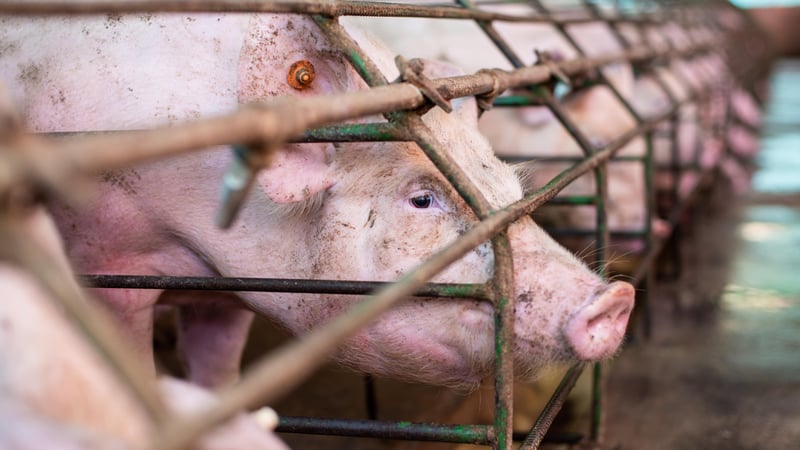
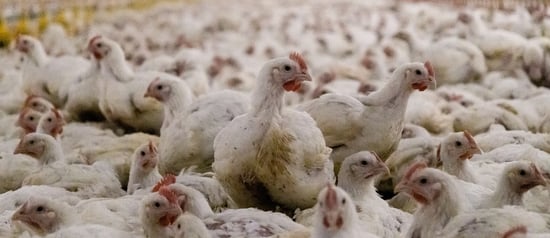
Every year in the UK, factory farms condemn millions of sentient animals to lives of misery. Chickens are bred to grow so quickly that many struggle to support their own bodyweight. Piglets routinely have their tails cut off without pain relief. Mother pigs are confined in cages so small they cannot even turn around while nursing their young. These are not isolated incidents, they are standard practices in industrial systems designed for maximum production, not humane treatment.

Industry representatives often argue that new barns are needed to reduce stocking density and improve welfare. But building more barns to house ever-growing numbers of animals does not address the root problem. We need to be producing less, not expanding infrastructure that locks farmers and animals into an inherently unsustainable system. Stocking density is only one part of a much bigger issue. The model itself relies on fast-growing breeds and keeps thousands of animals indoors for their entire lives.
Environmental damage and community impact
The environmental consequences are already clear. The crises in the River Wye and Lough Neagh show what happens when poultry production expands beyond ecological limits. Nutrient pollution from factory farming has devastated waterways, damaged biodiversity and affected local communities. Continuing to increase the number of chickens in already saturated regions will only deepen these problems.

Local communities are also making their voices heard. Recent planning objections across rural areas such as Norfolk demonstrate that residents do not want industrial-scale farms imposed on their landscapes. These developments can bring heavy traffic, pollution, odour and environmental risks, while offering limited long-term benefits to local economies. Rural communities deserve a meaningful say in decisions that affect their health, environment and future.
This is not the future of farming
This also raises a simple question about the kind of farming system the UK wants to support. Chickens belong outdoors, able to express natural behaviours such as scratching, dust bathing and exploring. Egg-laying hens increasingly benefit from free-range systems, yet meat chickens are still overwhelmingly raised indoors in intensive conditions. Free range should be the direction of travel for all poultry farming in the UK, not a niche option, but the standard we aim for.

Expanding factory farming also threatens the resilience of our food system. Industrial animal production is highly vulnerable to external shocks, including trade disruptions for imported feed, disease outbreaks, extreme heatwaves and flooding as the climate changes, and rising energy prices. A system built on large-scale, resource-intensive production is fragile, not secure.
The UK must shift toward higher-welfare, sustainable food systems that work for animals, people and the planet. That means supporting farmers to transition away from industrial models and toward systems that reduce animal numbers, improve welfare, protect the environment and strengthen rural economies. It also means ensuring that planning policies support this transition rather than undermining it.
Relaxing planning rules for factory farms would move the UK in the wrong direction. Instead of making it easier to build more industrial facilities, the government should focus on policies that encourage responsible farming, protect communities and safeguard our natural resources.
We urge the UK government to stop supporting the expansion of factory farming and commit to a just transition toward higher-welfare farming that protects animals, people, and the planet.
Call for an end to cruel factory farming
Sign our petition to the UK government and let them know that there is no future for factory farming.