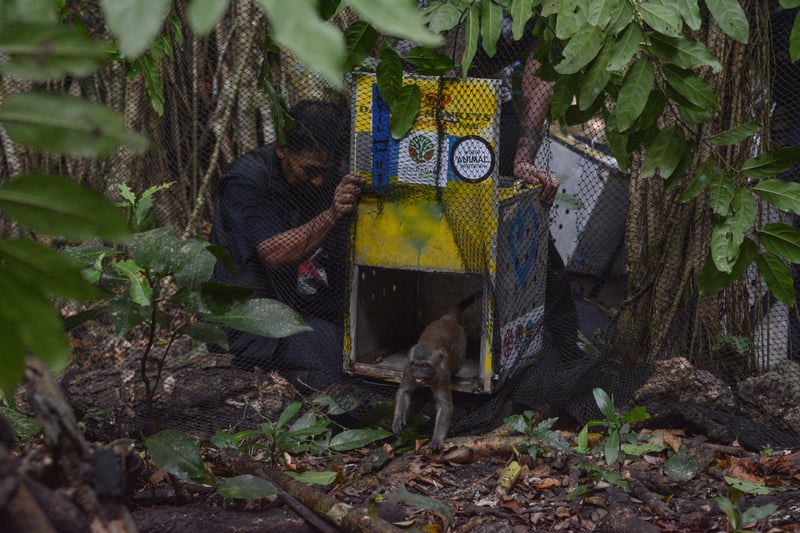
Rescued dancing monkeys take their first steps into freedom
News
Two long-tailed macaques rescued from Indonesia’s cruel dancing monkey trade have taken their first steps back into the wild after years of exploitation.
New rescue footage from Jakarta Animal Aid Network (JAAN) and World Animal Protection shows 7-year-old Jono and 3-year-old Unyil being released on 21 April on the protected Indonesian island of Nasu Burang, alongside 44 other rescued macaques.
This moment was a major milestone for the monkeys, who were rescued from a dancing monkey training centre in Cirebon in October 2024 after being forced to perform tricks for tourists and shoppers.
The pair reacted very differently to their new surroundings. Jono quickly disappeared into the dense forest as soon as his transport crate was opened, while Unyil took a more cautious approach, carefully observing the area before climbing into the trees and looking back at his rescuers.
Later, both monkeys appeared to be settling into life in the wild. Jono was seen spending time with other macaques in his group, while Unyil was filmed eating fruit he had found in the jungle.
The macaques were released on Nasu Burang, a protected island located 38km off the coast of Java. Allocated in partnership with the Indonesian Government, the island has no human settlements and provides a safe habitat with tropical forests, coastal forests and mangroves.
Before their full release, the monkeys were placed in a temporary habituation enclosure designed to help them gradually adjust to their new environment. JAAN researchers are continuing to monitor them to ensure they are able to find food and adapt successfully before they gain access to the rest of the island.
Getting the macaques to their new home was no easy task. Animal rescuers first transported them by small boat before carrying their crates on their backs during a demanding four-kilometre trek through dense tropical forest.

Rescued from years of cruelty
The 46 macaques had spent years being exploited in Indonesia’s dancing monkey trade, where they were forced to perform degrading tricks for entertainment.

When they were not performing, they were either chained to poles or confined in small black boxes. Jono and Unyil were kept chained close enough to see one another, but were unable to interact.
Following their rescue, the macaques spent 18 months at JAAN’s rehabilitation centre, where they received medical treatment and learned the skills needed to survive in the wild.
Jono had been forced to perform some of the industry’s most painful tricks, including walking on stilts, riding bikes and pushing a wooden barrel. His teeth had also been clipped, leaving him with severe dental problems and an infection that had spread to his nasal passage and ear canal.
When he first arrived at the rehabilitation centre, researchers described him as calm and observant. He developed a strong love of food, especially bananas and mangoes.
Unyil’s story is particularly heartbreaking. Stolen from his mother as a baby, he witnessed her being killed during his capture. He was then forced into captivity, where he was made to stand upright, wear clothes, beg for money and perform tricks including walking on stilts, playing dead and assuming prayer positions.
After 14 months of forced performances, Unyil arrived at the rehabilitation centre underweight and terrified. He would scream whenever he saw people and was afraid to interact with other monkeys. Since then, he has become a social and mischievous macaque who has bonded with his new family and developed a love of sweet fruit, especially watermelon.
Jono and Unyil will finally be able to live their lives where they belong, in the wild, with their new family.
Our partners Jakarta Animal Aid Network (JAAN) and local authorities have made great progress in stamping out the dancing monkey trade across much of Indonesia over the last 15 years. Sadly, macaques continue to be widely exploited for tourism. We look forward to the day when we can celebrate a nationwide ban on dancing monkeys.
A wider issue
Although the Cirebon facility was Indonesia’s last remaining dancing monkey training centre and has now been dismantled with support from local authorities, the exploitation of monkeys for entertainment remains a wider problem.
Image credits: Images are by JAAN