On the 18th of March the Government launched its Land Use Framework, reigniting debate about how Britain manages its countryside.
But what if we can have the environmental benefits of rewilding, while also producing food and actively managing, rather than abandoning, the land?
The notion of pristine wilderness untouched by humans still shapes how we think about conservation. Yet many landscapes, especially in the UK, evolved through long relationships between people, animals, and land management. Britain's landscapes evolved with human management, and there are ways we can manage the land which are far more ecologically sensitive than both factory farming and the simple "no-take" approach. The most effective conservation strategy might not be removing farmers from the land, but embedding wildness into their everyday work.
"Farm the land or preserve the wilderness", as it is usually presented in these debates, is a category error. World Animal Protection UK is exploring what “soft rewilding”, the re-integration of woodland and shrubland into active farmland, would look like.

What soft rewilding actually looks like
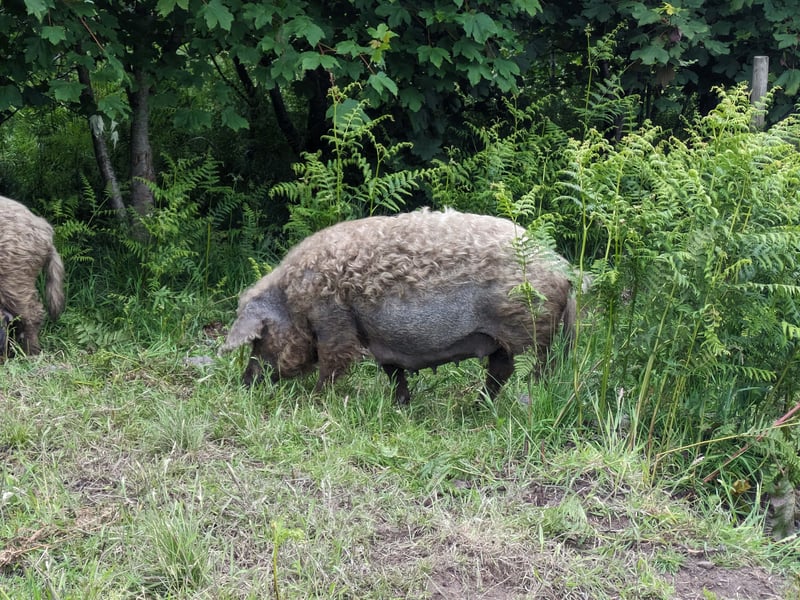
Rather than large-scale land abandonment, soft rewilding integrates ecological benefits into active, food-producing farmland through interventions that do not sacrifice output. That means moving animals through paddocks to mimic natural herd dynamics, investing in hedgerows as genuine ecosystem infrastructure rather than obstacles, and placing livestock under woodland canopies where they can forage naturally while the trees do the work of sequestering carbon.
Pigs and poultry thrive under far denser woodland canopies than current UK agroforestry grants support, sequestering dramatically more carbon while producing food.
The numbers on existing policy are stark. The UK government has committed to net zero by 2050 and to protecting 30% of land for nature by 2030. Current models assume this requires taking 21% of farmland out of production. But that assumption depends on keeping food production and nature recovery in separate boxes. In fact, in terms of producing higher-welfare and top quality animal protein, some of the most productive land is currently inactive woodland.
The case study that changes the conversation
Brodoclea Woodland Farm in Scotland is a pig farm nested within an existing woodland operation, mob-grazing rare Mangalitza pigs across 21 paddocks of mixed woodland. Products include meat, timber, and carbon capture.
The economic argument for this model is strong. Brodoclea's woodland-reared pork achieves near price-parity with factory-farmed meat when ecosystem services are valued at just £113 per acre, which is less than many existing agricultural subsidies. To put that in context: existing agroforestry grant support for cattle runs to £2,100 per acre, with ongoing payments of £50 per acre per year, and only plants around half as many trees as Brodoclea’s pig-system.
The farm is not yet charging for the carbon its woodland sequesters, nor for the biodiversity benefits its pigs create as they clear bracken and open up the forest floor. If those ecosystem services were properly accounted for, the case can be made that the pigs should actually be paid to be on site.
The "us and them" divide between farmers and conservationists is fading, as people in rural communities work together to create wilder, more productive landscapes.
The policy gap
The science is not the bottleneck. Policy is the bottleneck. Agroforestry grants currently exclude pigs and poultry. Funding encourages tree planting but not ongoing management. Carbon markets do not recognise silvopasture. Pioneering farmers are, in effect, giving away their environmental benefits for free, while remaining locked out of the funding structures designed to reward exactly this kind of work.
A key challenge in the current transition is ensuring that big estates do not simply secure available environmental payments for carbon schemes while doing less productive work, while innovative small-scale farmers at the vanguard of agroecology are left unable to access the finance they need. The Land Use Framework is an opportunity to fix that. It should reward integrated systems that deliver food, carbon, biodiversity, and animal welfare together, not treat these as competing priorities.

A vision worth fighting for
Nature protection is not incompatible with farming. Some species have evolved to thrive on the kind of farms that were, until the Green Revolution, the norm: plenty of hedgerows, mixed crops, low-density livestock, and traditional rotations involving ruminant cattle to improve the soil.
The National Food Strategy pointed toward a "have it all" scenario: less but better meat, carbon-negative farming, thriving rural economies. The price differential between sustainably produced and conventional animal products is smaller than commonly assumed, and with modest ecosystem service payments, it closes entirely. To “have it all” we need to take animal out of factories, and put them under trees where they belong.
Farming and rewilding should not be competing visions for the British countryside: They are two sides of the same just transition. The Land Use Framework should treat them that way.
Find out more about a Just Transition in UK Farming
A Just Transition means changing from harmful, factory farming to ways of farming that are better for animals, farmers, and the planet.
Read more