18 companies drop the Better Chicken Commitment in blow for millions of chickens
Blog
Eighteen companies that signed up to the Better Chicken Commitment have now announced they are dropping it. Instead, they are joining an industry-led initiative that removes the requirement to move to slower-growing breeds – the most important measure for chicken welfare.
What is the BCC?
The Better Chicken Commitment (BCC) was a pledge for companies to meet six science- and evidence-based measures designed to improve chicken welfare on factory farms by 2026. It is a global initiative, supported by many NGOs including ourselves. We even successfully got KFC and Nando’s to take the pledge.
To meet the commitment, companies agreed to:
-
Comply with all EU animal welfare laws and regulations, regardless of the country of production.
-
Implement a maximum stocking density of 30kg per square metre or less. Thinning is discouraged and, if practiced, must be limited to one thin per flock.
-
Adopt slower-growing breeds that demonstrate higher welfare outcomes and meet the RSPCA Broiler Breed Welfare Assessment Protocol.
-
Meet improved environmental standards, including brighter sheds with natural light, more perch space and enrichment, and clear air quality limits in line with EU rules, regardless of stocking density.
-
End the use of cages and multi-tier systems.
-
Adopt controlled atmospheric stunning using inert gas or multi-phase systems, or effective electrical stunning without live inversion.
-
Demonstrate compliance through third-party auditing and publish annual progress reports.
Why is breed so important?
Many of the companies that have stepped away from the BCC say they are meeting some or most of the criteria. But none have committed to switching to slower-growing breeds.
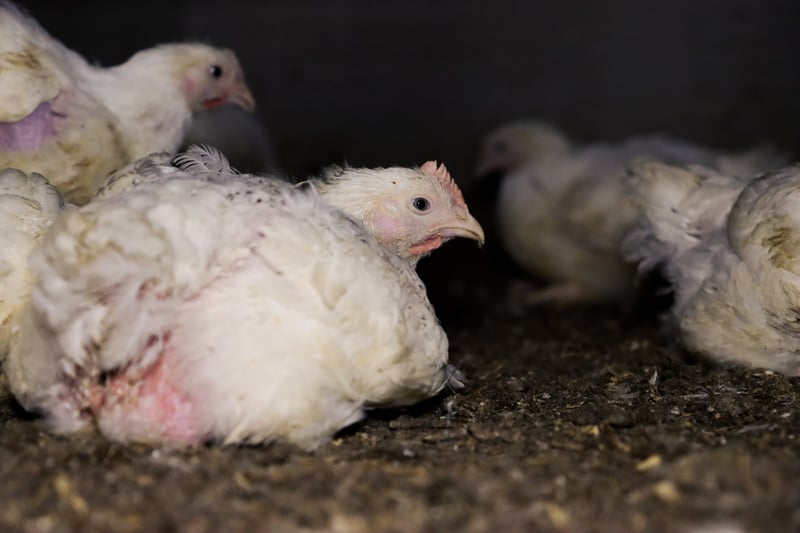
Fast-growing breeds are at the heart of the welfare crisis for chickens raised for meat. They have been selectively bred to reach slaughter weight in just over a month, when other breeds would still be chicks.
This unnatural growth puts immense strain on their bodies. Their bones, ligaments and organs cannot keep pace with rapid weight gain. They are also bred for disproportionately large breasts, leaving them front-heavy and unbalanced.
The result is widespread mobility problems. Many birds struggle to stand or walk and end up sitting in their own waste, causing painful ammonia burns. Others experience breathing difficulties as their hearts and lungs struggle under the weight of their bodies.
In these conditions, adding a little more space, light or enrichment does not solve the problem. Birds who can barely walk cannot make meaningful use of perches or extra space. They may even fall from perches because of their size and imbalance.
Without using appropriate breeds, chickens cannot have a life worth living, no matter how much their environment is adjusted.
Some companies argue that fast-growing breeds are better for the environment. Yet the ongoing damage to the River Wye from intensive chicken farm waste tells a different story. So does the deforestation in South America to grow soy for animal feed. The answer is not to produce more chickens more efficiently. It is to farm fewer animals, more sustainably.
What needs to happen now?
It is increasingly clear that voluntary commitments are not enough. The industry will not deliver meaningful change for chicken welfare without legislation.
World Animal Protection has moved beyond trying to make factory farms slightly better. We are calling for an end to factory farming. These systems drive animal suffering on a vast scale, in the UK and around the world.
We are urging the government to ban fast-growing breeds that do not meet the Five Freedoms set out in animal welfare law. We also want a ban on new or expanding intensive chicken farms.
At the same time, government support is needed to help shift towards eating less meat, including chicken. Farming fewer animals, raised to higher welfare standards, is the only way to create a food system that works for animals, people and the planet.
Just Transition for UK farming
A Just Transition is not about less farming - it’s about better farming, where people, animals, and the planet thrive.
Find out more