A day in the life at Brodoclea Woodland Farm in Scotland
Blog
As dawn breaks over the rolling hills of Ayrshire, Scotland, David Carruth begins his daily rounds at Brodoclea Woodland Farm.
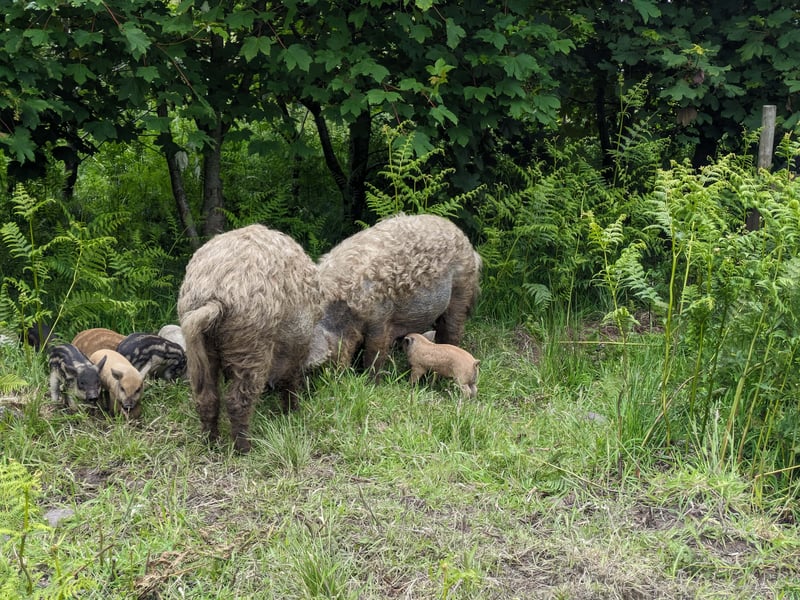
There’s no rush to fire up machinery or prepare sheds for thousands of animals. Instead, David heads out across the woodland to check on 83 woolly Mangalitsa pigs spread across 21 paddocks.
Unlike pigs on factory farms, these animals live outdoors year round. They move through woodland, forage for roots and nuts, wallow in mud, and choose where to rest. David’s first task each morning is simply to make sure they’re all safe and where they should be.

“The first thing I do is make sure everyone’s where they’re supposed to be,” David explains, navigating a rutted track in his mud-spattered Land Rover. “Pigs are clever, and occasionally they’ll find ways through the fencing.”
At the first paddock, the pigs come trotting over at the sound of the vehicle. They’re expecting their supplementary feed, a small top-up rather than the basis of their diet. On this farm, pigs source around 97% of their food directly from the woodland itself.
While many pig farmers are under pressure from rising feed prices, David spends his time managing trees, undergrowth and soil instead.
“We move the pigs every few weeks. It’s about balancing their impact, letting them clear undergrowth and turn soil but moving them before they over-disturb any area.”
It’s careful, considered work. The pigs play a role in restoring the woodland floor, improving soil health and creating space for new growth. In return, the woodland provides shelter, enrichment and food. This is farming that works with animals’ natural behaviours rather than trying to suppress them.
Later in the morning, David notices one sow has wandered away from the rest. Following her tracks through the trees, he finds her curled around a nest she has built herself from grasses and branches. Five piglets sleep inside.
“Factory pigs never get to build nests or raise their young naturally,” he notes.
Scenes like this are impossible in industrial systems, where animals are confined, tightly controlled and separated from their young. Here, pigs make their own choices. They root, explore, socialise and rest when they want to.
By midday, David is checking water supplies and looking ahead to the next paddock rotation. He keeps detailed maps of the farm, noting tree species, ground cover and seasonal food availability. Decisions are guided by ecology as much as productivity.
“Conventional farming fights nature with machinery, chemicals, and confinement,” he reflects, watching pigs forage among oak trees. “We’re working with natural behaviours and ecological cycles. It’s more complex but also more rewarding.”
As the afternoon draws on, the wider impact of this approach becomes clear. Where pigs have moved through, the woodland shows signs of renewal. Understorey plants reappear. Birds, insects and small mammals follow. Food production and nature recovery happen side by side.
This is the kind of farming many talk about but few feel able to adopt. Systems like this require time, knowledge and, crucially, the right support. For farmers to move away from industrial models without risking their livelihoods, they need policies that reward nature-friendly, higher welfare practices and recognise the true value they deliver.
As David finishes his final checks for the day, the pigs settle back into the trees, out of sight but very much at home.
“This isn’t just farming differently,” he says. “It’s reimagining what farming can be.”
Farms like Brodoclea show what a just transition in agriculture can look like in practice. One where animals live better lives, nature is restored, and farmers are supported to do things differently. The challenge now is making sure this way of farming isn’t the exception, but the future.
Find out more about a Just Transition in UK Farming
A Just Transition is not about less farming - it’s about better farming, where people, animals, and the planet thrive.
Read more